
By Abdulkarim Abdulmalik
Practical steps in education, dialogue, and community cooperation could transform fear into mutual respect between Muslims and Christians.
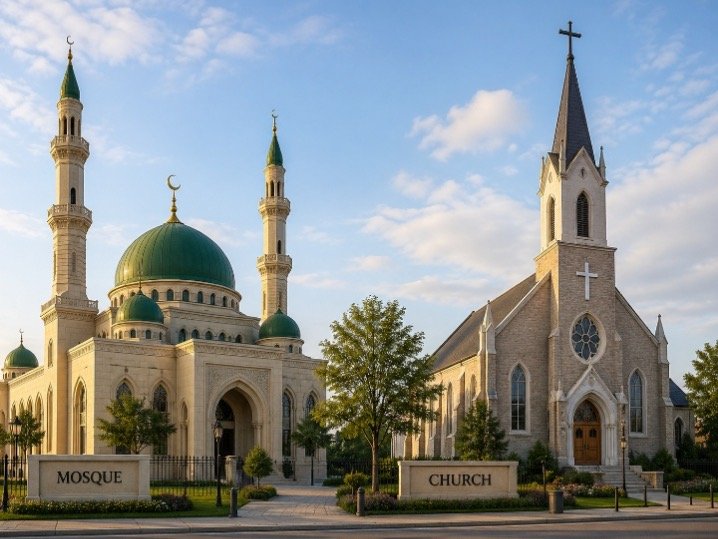
In Nigeria, diversity is not an abstract idea. It is a lived reality. From the bustling streets of Lagos in the South to the quiet towns of Yobe in the North, Muslims and Christians live side by side, sharing not only geography but also aspirations for peace, dignity, and progress.
Yet, despite this shared existence, suspicion and misunderstanding have too often shaped relations between the two faith communities.
The paradox is striking. A people so interconnected are yet so divided at times. But this division is neither inevitable nor irreversible. As aptly observed by the Guild of Interfaith Media Practitioners Nigeria (GIMP-Nigeria), “religious diversity is not a threat. Rather, it is Nigeria’s strength waiting to be harnessed.” The question is not whether Nigerians can live together peacefully. Ney, they already do. The real question is how to deepen that coexistence into genuine harmony.
The answer begins with education. Classrooms are not just places for academic instruction; they are spaces where perceptions are formed and biases can either be reinforced or dismantled. Teaching young Nigerians about the beliefs and values of both Islam and Christianity without prejudice or distortion, can provide the framework for mutual respect.
More importantly, schools must create opportunities for interaction: joint projects, debates, and community service initiatives that allow students to collaborate across religious lines. These experiences do more than inform; they transform.
Beyond the classroom, religious leaders stand as very strong and reliable agents of change. In a country where sermons often shape public opinion, Imams and Pastors should rise above rhetoric that divides. They should champion messages that unite.
Interfaith dialogue should not be limited to ceremonial meetings. It must address real societal challenges. When leaders from both faiths speak with one voice on issues like poverty, injustice, and insecurity, they demonstrate that moral values transcend religious boundaries. Their example carries weight, reminding followers that respect for others does not weaken faith but strengthens it.
Also important are the everyday spaces where life unfolds. Markets, playgrounds, and community centers offer natural opportunities for interaction. These shared environments can become enduring arenas for building trust. A simple football match between youths of different faiths or a joint community project can achieve what formal dialogue sometimes cannot.
After all, every shared conversation and cooperative project put fears at the bay. It builds understanding. Under this clime, familiarity breeds not contempt, but connection.
Another important agent harmony and tolerance is the mass media. In shaping public perception, the media plays a decisive role.
Too often, in the conventional media, negative stories dominate headlines, reinforcing stereotypes and deepening divisions.
Yet, there is another Nigeria – one where Muslims and Christians protect one another during crises, celebrate together, and collaborate for the common good. These are the stories that should be told more often. Responsible journalism can shift narratives from fear to hope, from division to unity.
The Social media, despite its challenges, also offers a platform to amplify voices of tolerance, especially among the youth who will shape Nigeria’s future.
Government action is plays a critical role. Policies must reflect fairness and inclusivity, ensuring that no group feels marginalized or excluded. Public institutions should embody neutrality, while laws against hate speech and incitement must be enforced consistently. When justice is seen to be impartial, trust grows.
Moreover, inclusive governance – where Muslims and Christians participate equally in decision-making – fosters a sense of shared ownership in the nation’s progress.
Still, the most profound change often begins at the grassroots level. Therefore, community-based organizations, youth groups, and women’s associations are uniquely positioned to bridge divides. Their initiatives – whether economic, social, or humanitarian – create opportunities for meaningful collaboration. These efforts remind people that beyond religious identities lie shared struggles and shared dreams.
At its heart, however, the journey toward religious harmony is deeply personal. It requires individuals to confront their own biases, to listen with empathy, and to reject narratives that undermine the faith of others.
At this point, parents and elders play a crucial role in shaping these attitudes, teaching younger generations that respect is not optional. It is essential.
Both Islam and Christianity call for compassion, justice, and love for one’s neighbor. In this shared moral vision lies a powerful foundation for unity. As the truth endures, faith calls for peace and understanding; certainly not division and conflict.
Today, Nigeria stands at a defining moment. Its diversity can remain a fault line. It can also become a foundation for strength. Thus, the path forward is clear but requires commitment laced with education, dialogue, community engagement, responsible media, inclusive governance, and personal responsibility.
The task may seem daunting, but change does not begin with grand gestures. It begins with small, consistent actions: a conversation across divides, a willingness to understand, a decision to cooperate. So, with time these actions accumulate, reshaping communities and, ultimately, the nation itself.
If Nigerians embrace this path, the future need not be defined by division. Instead, it can be shaped by a shared commitment to peace, where differences are not feared but respected, and where diversity becomes a source of unity. In such a Nigeria, religious harmony will no longer be an aspiration. Rather, it will be the lived experience of its people.
Abdulkarim Abdulmalik, an Abuja-based Journalist, is Chairman, Governing Board of the Guild of Interfaith Media Practitioners Nigeria (GIMP-Nigeria). He can be reached on info@interfaithmediaguild.org; nowmalik@gmail.com